Liquidity shocks, originator credit quality, and the institutionalization of alternative debt — a credit-analyst-level look at where European crowdlending really stands in 2026.
Introduction: The New Paradigm of European Alternative Debt
The European crowdlending market is undergoing a profound structural transition. For years, retail investors treated Peer-to-Peer (P2P) and Peer-to-Business (P2B) platforms as high-yield, quasi-passive savings accounts. Driven by aggressive marketing bonuses and sleek auto-invest algorithms, capital flowed seamlessly across borders, chasing double-digit Net Returns (XIRR).
However, recent macroeconomic pressures—sticky Eurozone inflation, shifting central bank policies, and localized legal bottlenecks—are exposing the architectural vulnerabilities of the market. The industry is rapidly moving away from blind algorithmic asset allocation toward rigorous, credit-analyst-level due diligence.
To maintain portfolio longevity, investors must look past the headline Click-Through Rates (CTR) and marketing yields. This analysis dissects the critical focal points of modern European crowdlending: the mathematics of cross-border liquidity shocks, the divergence in Loan Originator (LO) credit quality, and the strategic hybridization of alternative debt.
1. The Mechanics of a Liquidity Shock: Lessons from the Capital-Concentration Trap
One of the most underpriced risks in alternative lending is geographical capital concentration. When a platform becomes overly dependent on a single national demographic for its funding liquidity, it introduces a single point of failure.
The German Retail Conundrum
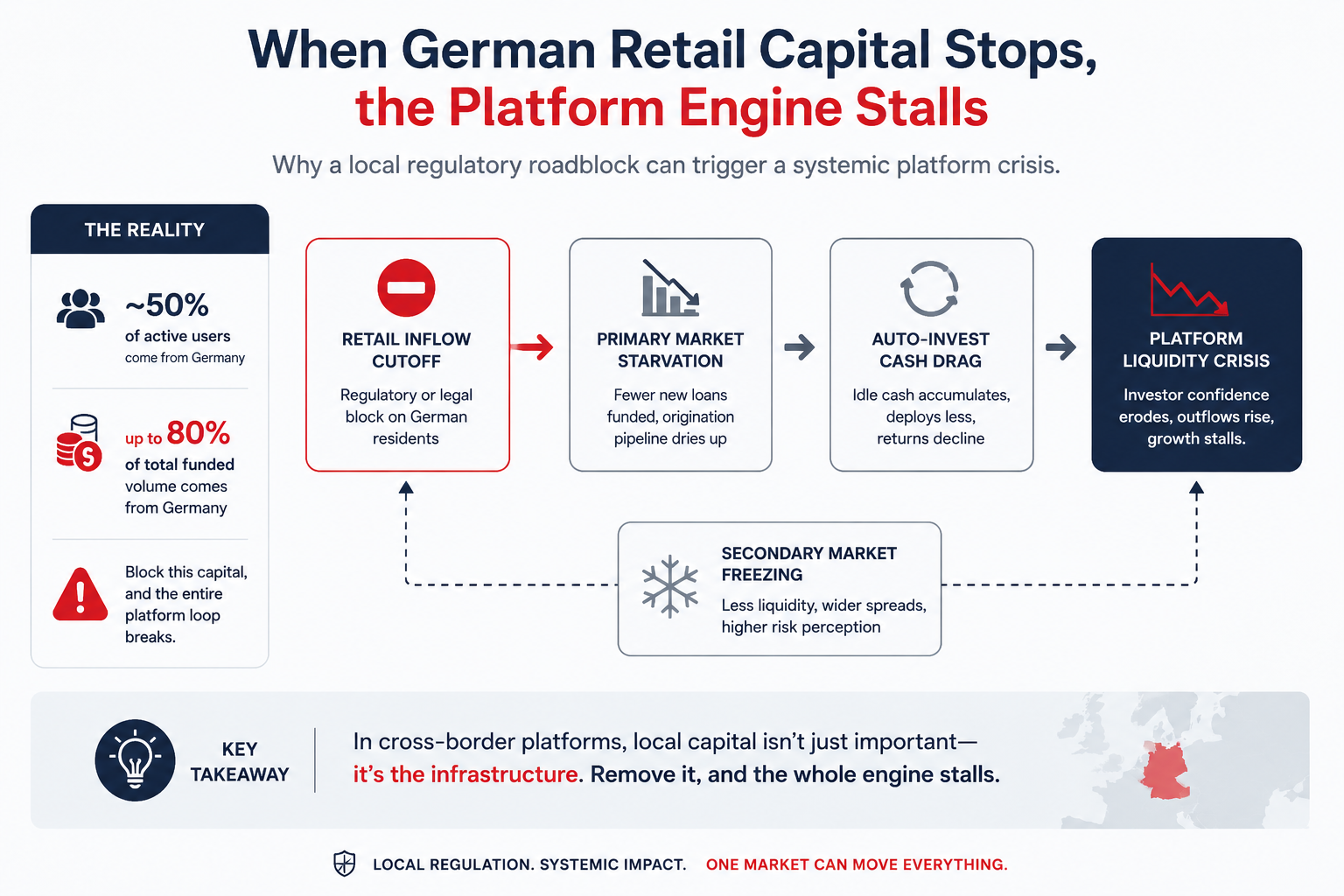
A clear case study emerged recently when Ventus, a prominent European platform, was forced to temporarily suspend new lending activities for German residents due to structural adjustments in cross-border legal agreements. While some market commentators dismissed this as a temporary compliance hiccup, the underlying numbers reveal a systemic threat.
In platforms of this profile, German retail capital often accounts for roughly 50% of the active user base but represents up to 80% of the total funded volume. When a regulatory or legal roadblock abruptly freezes this capital inflow, the operational loop of the platform breaks.
The Seasonal Cash-Flow Mismatch
When 80% of a platform's capital goes into "read-only" or capital-preservation mode (where investors deactivate compounding to withdraw monthly coupons), the platform enters a cash-flow squeeze. This risk is amplified if the underlying assets are highly seasonal (e.g., green energy, biomass, or heating infrastructure loans that experience sharp revenue declines during spring and summer months). Without incoming retail capital to bridge these seasonal revenue troughs, platforms face an existential choice: dilute asset underwriting standards to attract non-restricted cross-border capital, or enforce structural lock-ups (informally known in the community as corralitos).
Strategic Takeaway: True diversification requires analyzing not just where the loans are issued, but where the funding capital originates. Platforms with a highly fragmented investor base (spread evenly across France, Spain, the Baltics, and Benelux) possess significantly higher liquidity resilience than those structurally dependent on a single dominant nation.
2. Navigating the Loan Originator Minefield: Buyback vs. Group Guarantees
The term "Buyback Guarantee" has historically been used as a marketing shield to pacify risk-averse investors. However, as experienced investors learned during the historic restructuring phases of platforms like Lendermarket (Credistar) and Mintos, a guarantee is only as robust as the balance sheet backing it.
Deconstructing the Asset Quality Matrix
When assessing multi-originator marketplaces (such as Mintos or PeerBerry) or specialized holding groups (like MFG or Eleving), investors must distinguish between three distinct corporate layers:
- The Isolated Loan Originator (LO): Operating locally (e.g., Cashcredit or Sun Finance sub-entities). Its liquidity is tied directly to local non-performing loan (NPL) ratios.
- The Corporate Group Guarantee: A legally binding obligation where the parent holding company pledges its global assets to honor the buyback mismatches of its subsidiaries.
- The Platform Layer: The marketplace matching engine, which acts merely as an escrow and recovery agent, not a balance-sheet backer.
| Risk Variable | Isolated Loan Originator (LO) | Group-Backed Structure (e.g., MFG) | Marketplace Platform Only |
|---|---|---|---|
| Primary Risk Driver | Local NPL Ratios & Consumer Defaults | Global Capital Allocation Mismatches | Operational and Regulatory Sanctions |
| Liquidity Buffer | Restricted to Local Cash Reserves | Multi-Jurisdictional Treasury Pooling | Zero (Escrow/Custodian Accounts Only) |
| Recovery Timeline | 60–75 Days (Standard Buyback) | Instantaneous or Structured Roll-over | Long-term Court Restructuring (Years) |
The "Grace Period" Arbitrage: The Cost of Interest-Free Delays
A growing point of friction in the market is the rise of prolonged "Grace Periods" or "Prolongations." For instance, certain high-yield originators like Easy Credit offer attractive nominal rates reaching 15%. However, their legal frameworks often dictate that during the initial 30 to 60 days of loan delay, no late interest or penalty fees are accumulated.
From a financial engineering perspective, this turns into an interest-free loan granted by the retail investor to the originator. If an investor's portfolio consistently has 30% of its volume stuck in non-interest-bearing delayed states, the true Extended Internal Rate of Return (XIRR) drops significantly below the nominal target rate:
XIRR (Real) = Nominal Rate × (1 − % Delayed Non-Interest)
Conversely, originators like Kredis or MiPrestamo might offer lower nominal headlines (e.g., 9.5% – 10.5%) but enforce strict, instantaneous late-interest accruals from Day 1 of any payment mismatch. In a volatile economic market, the latter represents a structurally superior asset class for compounding stability.
3. The Institutionalization of Alternative Debt: The Rise of Fixed-Income Bonds
As the European crowdlending space matures under the harmonized European Crowdfunding Service Providers (ECSPR) framework, the line between retail P2P and traditional corporate finance is blurring. Market leaders are increasingly bypassing pure fractional P2P lending structures to issue regulated, senior secured debt.
Case Study: The Iute Group Bond Strategy
A premier indicator of this trend is the recent movement by Iute Group on the NASDAQ Baltic exchange. The group announced formal investor meetings for a potential Tap Issue (an expansion of an existing bond series) of its 12% Senior Secured Bonds maturing in 2030.
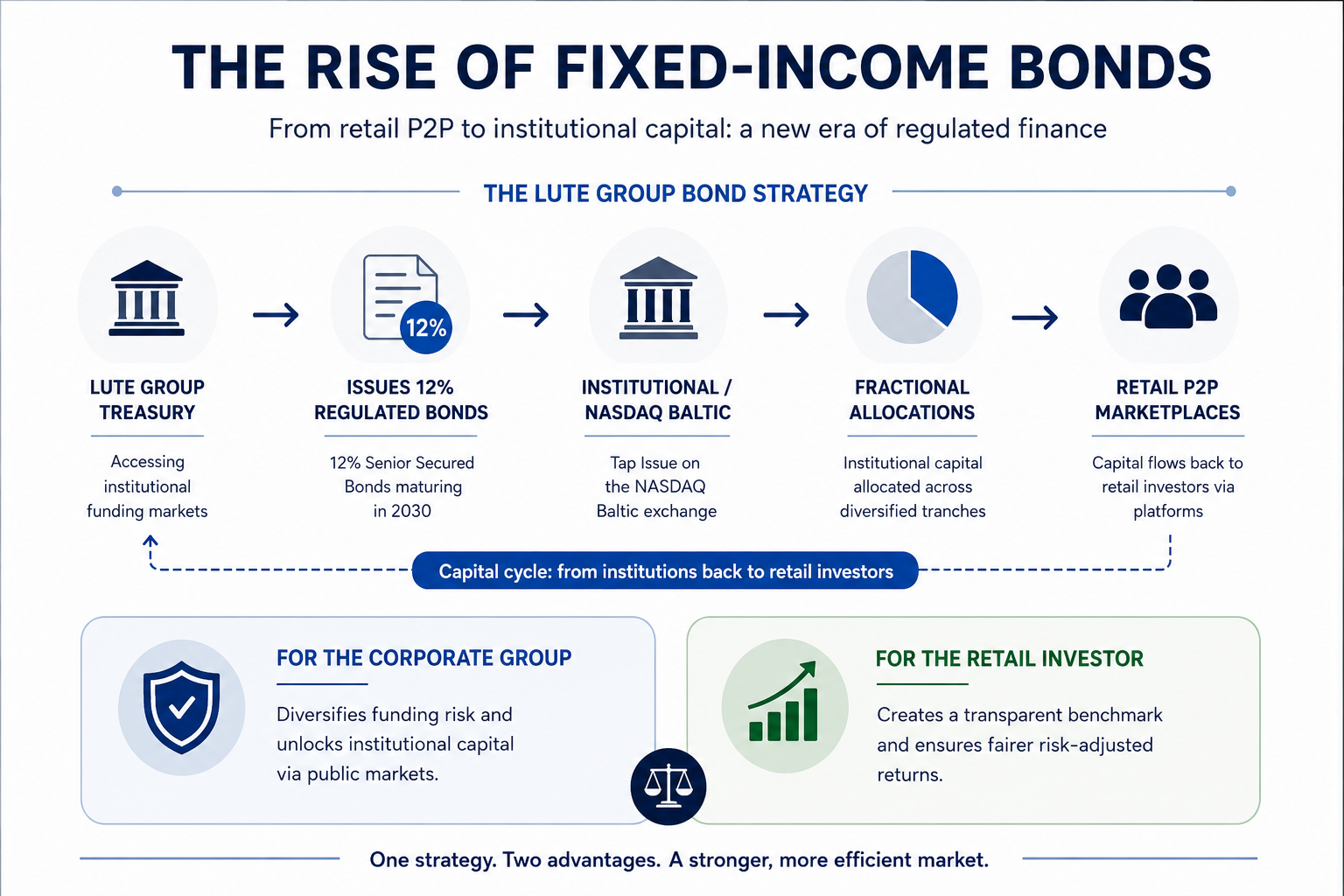
This strategic hybridization provides a dual-layered market view:
- For the Corporate Group: It diversifies funding risk. If retail P2P capital dries up due to platform-specific sentiment, the group can tap institutional capital via public bourses.
- For the Retail Investor: It establishes a clear market-priced benchmark. If Iute's institutional bonds trade at a yield-to-maturity of 12% on a regulated public exchange, any retail platform offering less than 12% for the exact same underlying corporate credit risk represents a mispriced asset allocation.
Investors should actively benchmark platform returns against the public bond yields of the same parent companies. If a platform offers 10.5% on an asset class where the institutional market demands 12%, the retail investor is taking on a premium deficit.
4. The Quantitative Health Check: Real-World Portfolio Metrics
To transition away from "passive vanity metrics," investors must maintain a strict quantitative assessment of platform health. The following three metrics should replace simple "Account Value" tracking:
1. The Delayed-to-Active Ratio (DAR)
DAR = Total Capital in 31+ Days Delay ÷ Total Active Portfolio Value
- Healthy: < 15%
- Systemic Risk Flag: > 25% (Indicates structural collection inefficiency or deteriorating underwriter filters at the originator level).
2. The Net Realized Recovery Velocity (NRRV)
This tracks how much capital actually returns to the cash account after a platform triggers its default recovery mode. During historic restructuring events (like the Credistar transition from LM1 to LM2), capital was temporarily trapped in a de facto capital freeze. Although 100% of the principal was eventually recovered with interest over a 24-month horizon, the opportunity cost of that idle capital must be deducted from the platform's lifetime performance score.
3. The Automation Efficiency Gap
Many premium legacy platforms, such as PeerBerry, boast massive daily loan volumes but suffer from an Automation Efficiency Gap. When a platform relies heavily on manual updates or lacks a truly dynamic, AI-driven auto-invest architecture, investors experience severe cash drag (idle capital sitting in uninvested cash balances). A nominal 11% portfolio with a 15% cash drag yields a real-world drag-adjusted return of only 9.35%.
Conclusion: The Flight to Transparency and Structural Integrity
The European crowdlending ecosystem is no longer in its infancy. The platforms that will survive the ongoing macroeconomic cycle are not those offering the flashiest signup bonuses or the highest unbacked nominal yields, but those displaying institutional-grade operational resilience.
As an investor, your capital allocation matrix should be guided by three non-negotiable pillars:
- Funding Source Fragmentation: Avoid platforms overly reliant on a single national demographic.
- Contractual Transparency: Prioritize originators that pay penalty interest during grace periods over those utilizing interest-free extensions.
- Regulatory Harmonization: Favor platforms operating under robust frameworks (like ECSPR) that enforce clear segregation of client funds and strict asset-liability matching.
The crowdlending market remains one of the most powerful tools for generating superior alpha in the alternative debt space—provided you treat the asset class with the same analytical rigor as a traditional credit committee.
Find platforms that meet our standards
Compare every European crowdlending operator scored on transparency, regulation and track record.
Explore the ranking