Displayed yields are projections, not reality. A field guide to computing your true XIRR, tracking the Delayed-to-Active ratio, and auditing recovery velocity like a credit analyst.
Introduction: The Illusion of Displayed Yields
In the wake of recent market adjustments shaking the European crowdlending space, a critical truth has emerged for the investor community: the interest rate displayed on a project sheet is merely a projection, not an accounting reality. For years, many platforms have heavily marketed high internal rates of return (IRR) or flattering average interest rates to capture retail capital.
However, in 2026, as recovery timelines stretch and certain loan originators undergo heavy restructurings, these surface-level metrics are no longer enough. To manage a passive income portfolio with true peace of mind, the modern alternative debt investor must adopt the stance of an auditor. This requires mastering two non-negotiable skills: calculating your True XIRR (the annualized internal rate of return factoring in the exact timing of cash flows) and independently auditing platform solvency.
1. Calculating True XIRR: Factoring in the Invisible Costs of Cash Drag and Late Payments
The XIRR (Extended Internal Rate of Return) is the ultimate mathematical metric because it maps out the exact dates of every single cash movement (deposits, withdrawals, and repayments). Many investors make the mistake of relying blindly on their platform's dashboard, which usually calculates a theoretical yield based solely on active, performing loans.
To extract your True XIRR, you must export your raw transaction ledger and account for two performance-killing variables:
Cash Drag (The Idle Capital Tax)
When your capital sits unallocated in a platform wallet for days or weeks between projects—due to lack of inventory or slow subscription phases—its yield is 0%. This idle time mathematically dilutes the global XIRR of your portfolio.
The Extension Freeze
A project displaying a 12% nominal interest rate that suffers a 6-month repayment delay without compounding penalty rates will see its real XIRR plummet. Time is the absolute enemy of fixed-income performance.
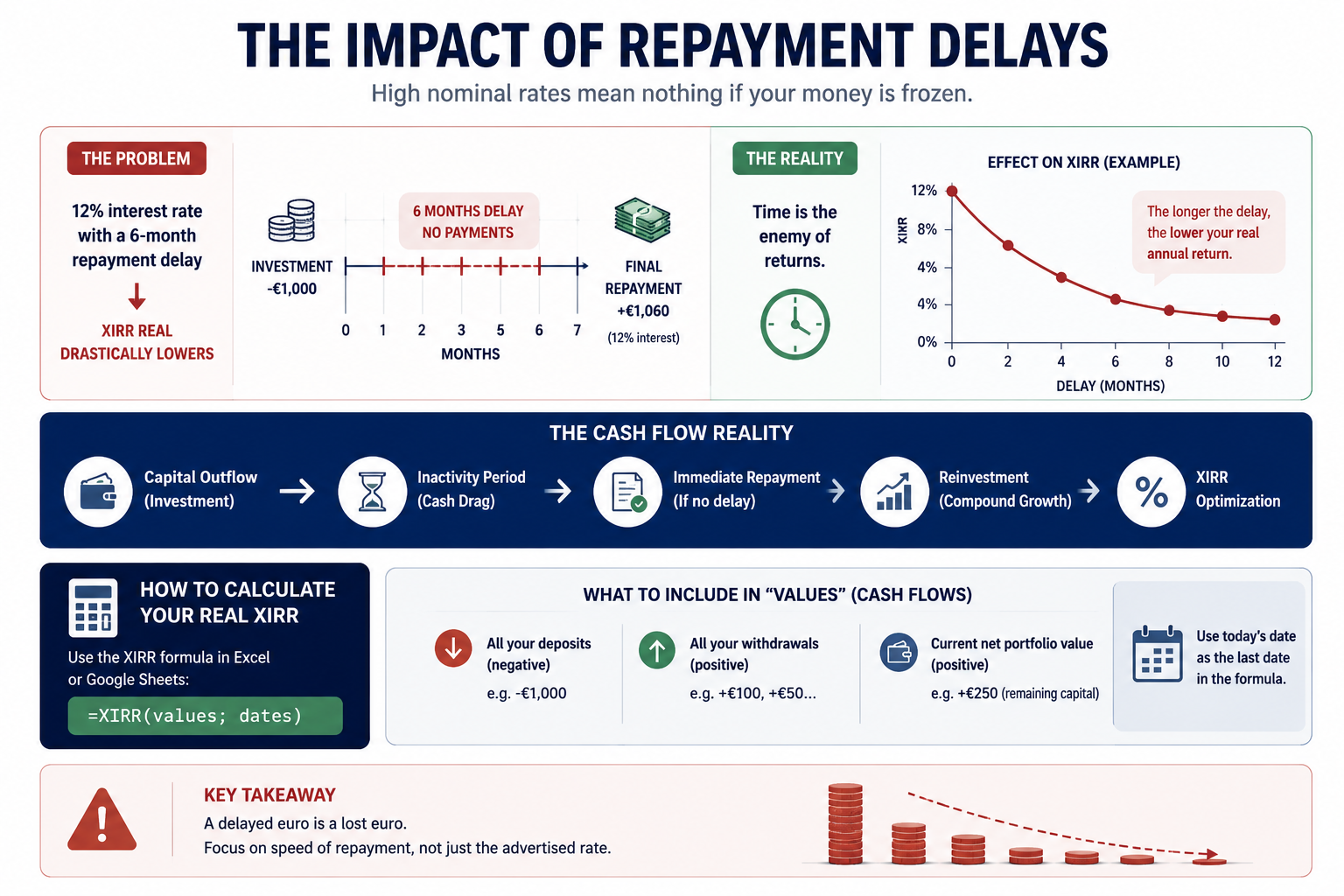
To calculate your True XIRR in Excel or Google Sheets, utilize the formula:
=XIRR(values, dates)
The "values" column must include all your historical deposits (as negative numbers), all your withdrawals (as positive numbers), and the current net asset value of your safe, outstanding principal (as a positive number) dated as of today.
2. The "Delayed-to-Active" (DTA) Ratio: Your Early Warning System
Auditing a platform implies looking past individual campaigns to analyze its global outstanding portfolio. The most critical health indicator—and one that discrete platforms often try to hide behind complex UI layouts—is the Delayed-to-Active (DTA) Ratio.
DTA Ratio = Total Volume of Late Loans (+30 Days Due) ÷ Total Active Portfolio Volume
Below 5%: Green Zone
The platform maintains outstanding underwriting standards and credit sourcing. Late payments are marginal, isolated, and resolved swiftly within standard administrative windows.
Between 5% and 15%: Orange Zone
Macroeconomic tensions are building up. This requires immediate action from the investor: stop automated investment engines, transition to manual project selection, and increase cross-platform diversification.
Above 15%: Red Zone
The platform is facing structural defaults among its primary developers or originators. The systemic risk of a liquidity freeze or capital lock-up increases exponentially.
A professional auditor ignores the "Total Funded Capital since Inception" (a pure vanity metric) and exclusively tracks the 6-month rolling trend of this DTA ratio.
3. Assessing Net Recovery Velocity
When an inevitable default or prolonged delay occurs, platform marketing claims become irrelevant. The only metric that matters to your net return is Net Recovery Velocity—the operational and legal capacity of the platform's management team to reclaim stuck capital.
To evaluate a platform's recovery framework, look at past incidents using three cold criteria:
- Collateral Execution: Are first-rank mortgages liquidated through judicial enforcement within a reasonable 12-month window, or does the platform get bogged down in endless out-of-court restructurings with insolvent developers?
- Crisis Communications: Are default updates monthly, granular, and backed by legal filing numbers, or are investors left with vague, repetitive statements like "discussions are ongoing"?
- Recovery Cost Burden: Are heavy legal and court fees internalised by the platform, or are they deducted directly from the final capital recovered, shifting the loss onto the retail investor?
A platform with an institutional-grade legal recovery desk can temporarily survive a higher DTA ratio, provided their conversion rate from default back to liquidity remains high.
Conclusion: Reclaiming Control Over Passive Assets
The era of "set-and-forget" passive investing in European crowdlending is officially over. In 2026, the dividing line between a profitable portfolio and a frozen account lies in audit discipline.
Calculating your own independent XIRR cuts straight through dashboard marketing illusions. Simultaneously, tracking the Delayed-to-Active ratio and demanding radical transparency on recovery velocity are your only real weapons to protect consistent cash flows. In a mature market, diversification is no longer a shield; cold, data-driven selectivity is.
Find platforms that meet our standards
Compare every European crowdlending operator scored on transparency, regulation and track record.
Explore the ranking